
BILL VRYONIS — FROM ARCHETYPE TO KOMMOS
Two years ago, Culture of Balkans welcomed young Greek writer-director Bill Vryonis to discuss his debut feature film, ARCHETYPE.
Made on an exceptionally limited budget and without the backing of a production company, the film made its first appearance at the AGORA Film Market of the 65th Thessaloniki International Film Festival and was featured on Cinando, the official industry platform of the Cannes Film Festival, before going on to become a finalist at international film festivals in Sweden and Italy.
In our first interview, we spoke about his relationship with cinema, his artistic influences, and the challenges of bringing a feature film to life with virtually no resources.
Nearly two years after the completion of ARCHETYPE, Vryonis returns to share details about his next film, KOMMOS, which is intended to be his second feature and is currently in development.
We sat down with him to discuss the road ahead and everything that has unfolded since his first steps into filmmaking.
CULTURE OF BALKANS: Bill, it's a pleasure to have you back. When we last spoke two years ago, we discussed what might come next after ARCHETYPE. Now, you're ready to share some details about your upcoming project, KOMMOS. Is this the film you had in mind back then, or have things changed along the way?
BILL VRYONIS: It's a pleasure to be here again. Since completing ARCHETYPE, I've spent a great deal of time developing new screenplays and revisiting older ones. When deciding which project to pursue next, you have to take into account the resources available. You don't want to compromise an ambitious screenplay by attempting to make it with less than it requires. When we last spoke in 2024, I had a different project in mind, but I eventually set it aside in favor of KOMMOS, a film I find far more exciting and unique.
C.O.B.: Looking back at the experience of making ARCHETYPE, what would you say are the most important lessons you've learned that you'll carry with you into the future?
B.V.: When I first started assembling the cast and crew of ARCHETYPE, I had a strange sense of confidence, perhaps even a certain naïveté, about how the whole film would come together. I knew it was going to be difficult, considering we basically had no budget and lacked much of the equipment we needed. But when you're on set, having planned ten shots and managing to get only five, often not even the way you intended, you begin to realize just how difficult filmmaking really is. I think the two most essential lessons I took away from that experience were the importance of discipline and extensive preparation. Those are certainly the things I'll carry with me into future projects.
C.O.B.: Let's get back to KOMMOS. What can you tell us about the film's title and genre?
B.V.: It's a little difficult for me to strictly classify the film by genre or discuss the meaning behind its title when it hasn't even been made yet. I would describe KOMMOS as a thriller with elements of film noir, although genre labels can sometimes be misleading, especially when a film doesn't strictly adhere to their conventions.
As for the title, I've always been very particular about how I title my scripts.
I'm always looking for something distinctive that symbolically captures the essence of the story, but with a certain degree of subtlety. Of course, finding a title that hasn't been used before is another consideration. Beyond that, I'd rather not reveal too much about its meaning just yet. I hope that's not too disappointing.
C.O.B.: Not at all. KOMMOS seems like a very different film from ARCHETYPE, both in terms of genre and tone. Was this a conscious decision on your part, and do you see a creative connection between the two films?
B.V.: ARCHETYPE was, at its core, a coming-of-age story told in a surrealistic manner, almost like a Richard Linklater film meets a David Lynch film. It was essentially an exploration of its protagonist's inner and outer worlds, using cinema to reveal his psychological and emotional struggles in a way that felt unique to the medium.
KOMMOS, on the other hand, is a completely different film in almost every respect. If there's one common thread between them, beyond the fact that I wrote both, it's that they each revolve around a protagonist who has reached his absolute breaking point.
For me, though, the desire to make a film is a much more emotional process than an intellectual one. I didn't set out to make a completely different film simply for the sake of differentiating myself from my previous work. There are so many subjects and genres I'd love to explore, and I've always admired filmmakers who can move effortlessly between different kinds of stories. I aspire to that kind of versatility myself.
C.O.B.: Would you say KOMMOS is a more mature film than ARCHETYPE?
B.V.: I think that's another trap we fall into when trying to categorize films. I don't really think in those terms. You can make a film about something very small and intimate, or one that deals with events of enormous historical significance.
That doesn't necessarily make the latter a more mature film than the former.
But to answer your question, KOMMOS will be the work of a more mature filmmaker and a more mature person. That doesn't necessarily mean it will be a more mature film than ARCHETYPE. That's for the audience to decide.
C.O.B.: ARCHETYPE was made with extremely limited resources and without the backing of a production company. Are the circumstances any different for KOMMOS?
B.V.: ARCHETYPE showed me what can be achieved with very limited resources, but also how important it is to have the right production conditions in place.
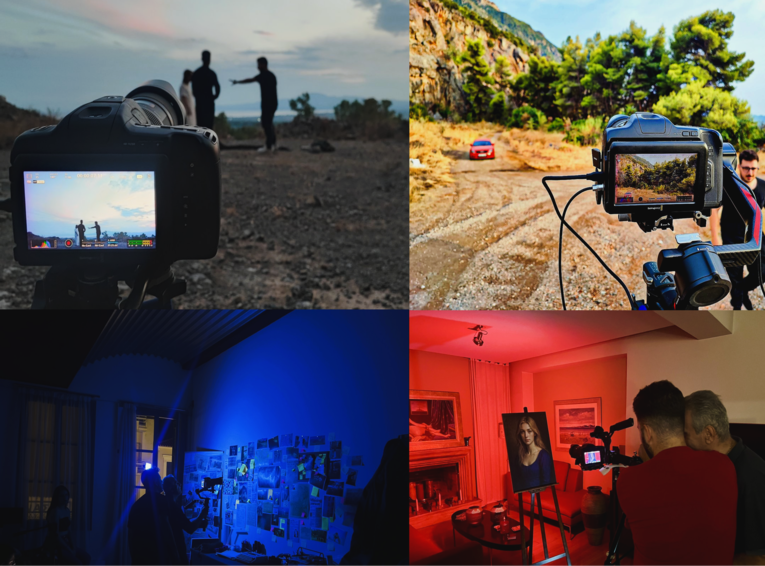
KOMMOS is a project with significant technical and logistical demands, and bringing it to life requires external financing. To help attract additional investors, we've already shot a small portion of the script and put together a teaser trailer, which is now available on the film's IMDb page. The idea behind the teaser is to convey the film's tone, atmosphere, and overall aesthetic without revealing any details about the story or its subject matter. It's a similar approach to the one the Coen brothers took when they were trying to finance their debut feature, Blood Simple.
At this stage, the creative team is already in place, and I have the pleasure of working with both familiar faces from ARCHETYPE and new collaborators. We share a common vision for the film, and we're all determined to bring it to life and realize its full potential.
C.O.B.: Do you think making a film in a language other than English presents a challenge when it comes to reaching an international audience?
B.V.: Language is definitely a big barrier. Many of us have grown up watching predominantly American films. We've become so accustomed to hearing English spoken on screen that watching a film in another language can sometimes feel like a different cinematic experience altogether, almost like a heightened reality. In the case of KOMMOS, however, we've figured out a way to dance around that barrier.
C.O.B.: You mean the actors speak English?
B.V.: Without giving too much away, the film is about something timeless, and for the story to work, it needs to be approached with a certain degree of universality. That means elements such as language and the country in which the film is set have to be handled with great subtlety and care. I know that doesn't really answer your question.
C.O.B.: It’s ok, I understand you don’t want to spoil things. ARCHETYPE began its festival run in 2024, almost two years ago. Since then, which films would you say have had the greatest influence on you as a filmmaker?
B.V.: I think the films that truly shaped me did so during my childhood and teenage years. By the time you reach adulthood, a large part of who you are has already been formed. I'm still in my twenties, so perhaps I'll need a few more years to fully appreciate the influence of the films I'm watching today. That said, I can certainly name a few that have been particularly important to me over the past couple of years. Would five be alright?
C.O.B.: Five would be perfect.
Following (1998) — Christopher Nolan
B.V.: Christopher Nolan is a filmmaker I grew up with. I've been obsessively watching his films since I was six, when I first saw Batman Begins in 2005.
When it came time to make my own debut feature, it was Nolan's first film, Following, that inspired me the most. The fact that he managed to make it on a budget of just £5,000, shooting on weekends with the help of family and friends, gave me the confidence to believe that I could make a feature film myself.
8½ (1963) — Federico Fellini
B.V.: Fellini is one of my favorite filmmakers, and 8½ is by far my favorite film of his.
The way it blends reality with fantasy, along with its exploration of a filmmaker whose artistic ambitions and personal flaws have taken a toll on his personal life,
is something I've always found relatable.
Its influence on ARCHETYPE was significant, even if I wasn't entirely conscious of it at the time.
The Good, the Bad and the Ugly (1966) — Sergio Leone
B.V.: For older generations, John Ford might have been the definitive director of the Western genre, with John Wayne representing the ultimate archetype of the Old West. When I was growing up, though, the Western was often synonymous with Sergio Leone, Clint Eastwood, and the final installment of the Dollars Trilogy in particular, The Good, the Bad and the Ugly.
It was the film that introduced me to the Western genre, and although I've since developed a preference for classic American Westerns over spaghetti Westerns, Leone's magnum opus remains one of my absolute favorite films in the genre and one of my favorite films of all time.
Days of Heaven (1978) — Terrence Malick
B.V.: Days of Heaven was the first Terrence Malick film I ever watched, and it opened the door to the work of one of my favorite filmmakers of all time.
Malick's films have a way of staying with you long after you've seen them. They nest inside your mind and heart, whispering in your ear until you begin to remember them as dreams of your own. I find his films profoundly moving and groundbreaking, both cinematically and in their exploration of existential themes.
Days of Heaven holds a special place in my heart, not only because it introduced me to Malick's cinema, but also because it tells a deeply tragic story that feels timeless, almost ancient, despite being set in Texas in the 1910s.
The Killing of a Sacred Deer (2017) — Yorgos Lanthimos
B.V.: For a more contemporary pick, I'd go with my favorite film by Yorgos Lanthimos, The Killing of a Sacred Deer.
There's something very grounded about it, in the sense that it takes place in a modern, recognizable reality. Yet the way Lanthimos and his co-screenwriter, Efthimis Filippou, bring something ancient into a contemporary setting, along with their distinctive style, creates a truly powerful and psychologically penetrating cinematic experience. It's a brilliant nightmare that attacks the subconscious.
C.O.B.: And finally, Bill, if ARCHETYPE was the beginning, what does KOMMOS represent for you?
B.V.: ARCHETYPE was born out of the need to begin. KOMMOS is born out of the need to continue. And perhaps that second need is even stronger than the first.
C.O.B.: Bill, we wish you all the best on the journey ahead. We hope the film comes together just as you envision it, and we'll be here to follow its progress and cover its development and production.
B.V.: Thank you for having me again.
The promotional trailer for KOMMOS, along with additional information about the film, can be found on its IMDb page.
Leave your comments
Post comment as a guest